

Moralizing and Medicalizing Fatness
Why these two M's matter in fat liberation

I recently had the pleasure of speaking with Kelsey Kramer McGinnis as she is writing her next book on wellness culture and Christianity, which I am stoked to read when it’s finished. As we spoke about fat liberation and body size within a faith and cultural context, two M-words rose to the top of our conversation: morality and medicalization.
The Moralization of Fatness
In my journey over the past ten plus years as a fat activist and person of faith, I have encountered the morality of body size in a significant way. So many Christians hold a deep-seated belief that thinness is close to godliness. The Apostle Paul has several verses that have been co-opted by purveyors of the thin-is-godly worldview (i.e. the body is a temple interpreted as an imperative for physical health, among others). I have written extensively about this in my first book Lovely: How I Learned to Embrace the Body God Gave Me and my second book More of You: The Fat Girl’s Field Guide to the Modern World.
But even outside of a Christian worldview, body size is moralized. Note how good guys are trim and fit while the big baddie is just that—big. Thin is good and fat is bad. It’s practically inescapable, hitting us in our tropes and even in our health food marketing. (Food marketed as “good” when it has less fat…)
Once we realize that body size is morally neutral, we can begin the journey toward fat liberation. Until then, we are stuck in the fat-is-bad and therefore fat-people-are-bad cycle, which is harmful to all of us.
[If you’re a person of faith and are annoyed with The Daniel Fast and other Christian diet books, I have a podcast rec for you—my episode of Fat & Faithful with Dr. Aubrey Buster, on why the Daniel fast is a stupid reason to diet…]
So, once we detangle ourselves from the morality of body size, we have to fight the medicalization of body size.
The Medicalization of Fatness
Another M- phenomenon is the medicalization of fatness.
Fatness has always existed in the human species. It’s not new, and it’s not the result of GMOs or ultra-processed foods.
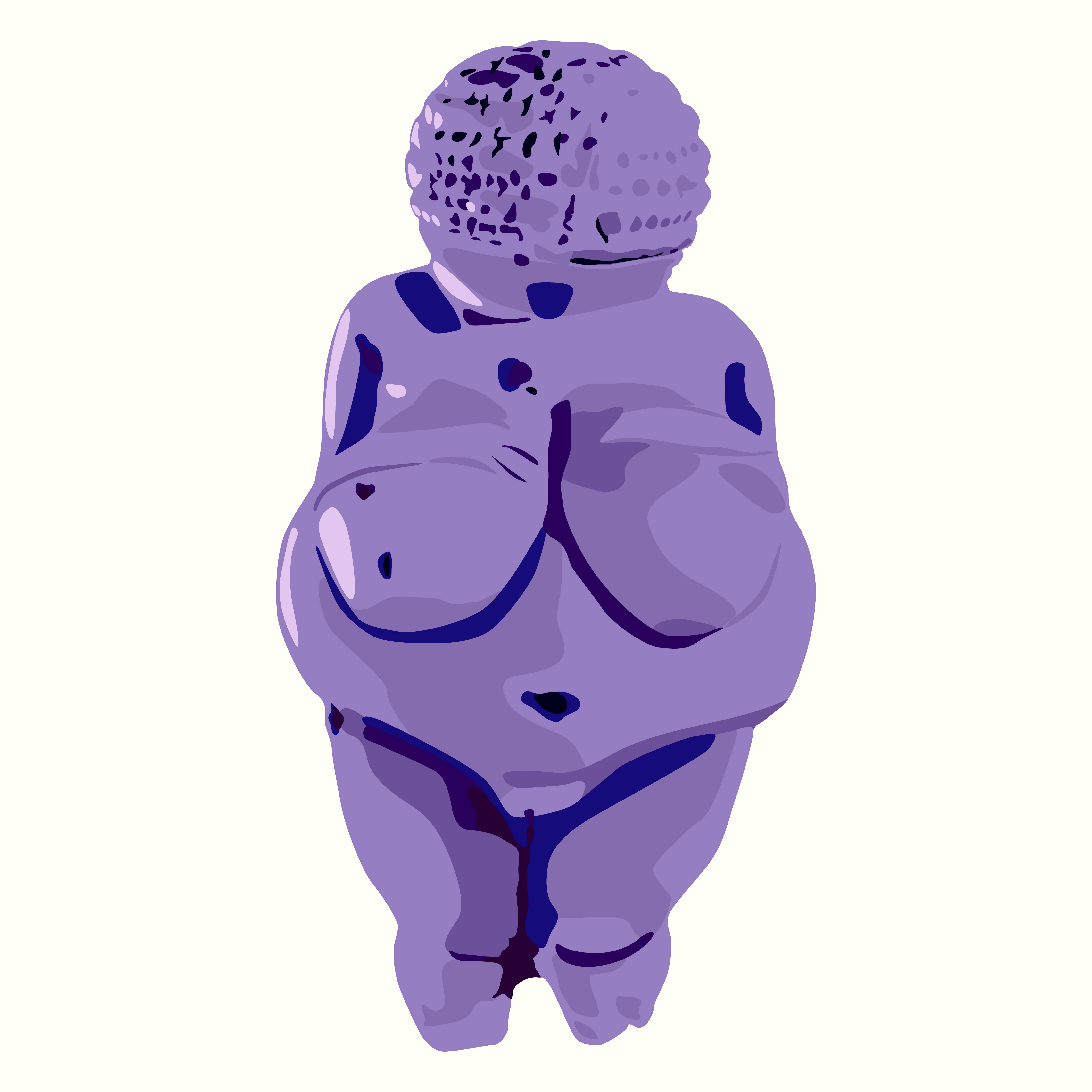
I know that we were sold a paleo diet on the assumption that paleo-era humans (whatever that means!) were all trim and fit because they didn’t eat cultivated grains. But take a look at the Venus of Willendorf, stylized here in my favorite color, purple.
Also, this was the logo for my podcast of old, Fat & Faithful. (You can still listen to all the episodes here!)
Anyway, body size has only recently been medicalized. And I’m not talking about relative to human existence…I’m talking about a few of handfuls of years…
Like 13 years ago.
In 2013, the American Medical Association voted to classify ‘obesity’* as a disease. However… “The AMA decision is controversial, since the AMA’s own Council on Science and Public Health in 2012 said that there was not sufficient data to support calling obesity a disease” (this article).
Before 2013, ‘obesity’ was not considered an illness. But it is now. And now we have the proliferation of medications targeted to this “disease.” By changing the classification of ‘obesity’ to a disease rather than just a way that human bodies can exist in the world, the medical establishment solidified (already extant) medical prejudice against bodies like mine. I firmly believe that the moralizing of fatness led to its medicalization, and that is just a really really irresponsible way to do medicine. Shame on you, AMA.
In 2025, I wrote about my journey with semaglutide in my posts Ozempic and Me. For several years now, I have been on Ozempic for type 2 diabetes, and even though it was never my goal, I have lost some weight while on the drug. And even though my blood sugars are completely under control at a low dose, I have the medical option to up my dose in order to lose weight, and my insurance would cover it.
Let me reiterate—my actual disease is managed through medicine, but they want to medically manage my body size. Because it’s bad.
Why does it matter if fatness is medicalized?
It makes it seem like health is thinness and thinness is health.
It gives people with economic advantages the ability to seek thinness, while villainizing those in poverty who find themselves in large bodies.
It pathologizes something largely genetically determined in order to make money for pharmaceutical companies.
If we can accept that the variety of trees in our world are different shapes and sizes, why can’t we accept the same diversity in body size? A great resource on this idea is this video from the Association for Size Diversity and Health (ASDAH): Poodle Science. We don’t treat every dog like a poodle—so why should we treat every human like a size 00 model medically?
So, maybe this is the first time you’ve considered the morality and medicalization of body size—or fatness, specifically.
What can you do?
First, you can reject the morality of body size. All bodies are good bodies. And a body is good because it fulfills its purpose, which is relationship—not thinness or health.
Second, you can reject the medicalization mentality about body size. Body size diversity is as natural as other kinds of biodiversity.
These begin with your mind, heart, and body. But these convictions can carry out in your social media posting and pushing back against your physician if they attempt to medicalize your body or shame you into weight loss.
I’m here with you on the journey.
~Amanda
I recently watched a video from Fr Mike and Ascension about bodies and it sent me into a tailspin. Thank you so much for your work being fat and faithful and talking about those intersections. You are one of the voices I turn to to drown out the outside noise.
Hear, hear! It is so insidious, this fat-hate. Baked into every fiber of our culture. It is a convenient way to control *especially* women, keeping us so busy fixating on our size and every aspect of our appearance, chasing after a fake standard of invented "beauty" that we don't notice our agency and personhood being stolen. Fuck. That.