

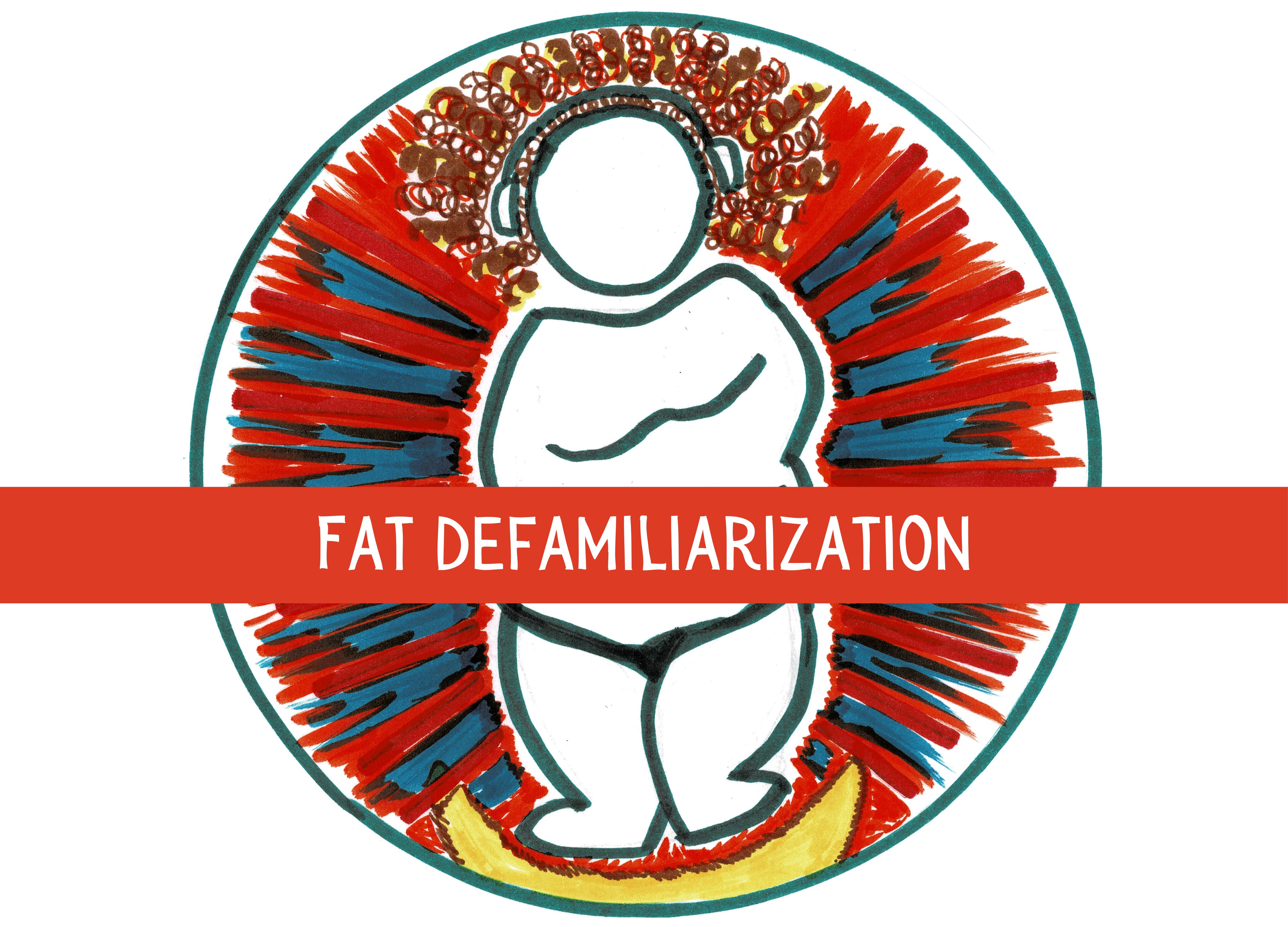
Fat Defamiliarization
It's a mouthful, but it's so helpful.

Trigger warning: This post includes discussion of fasting for religious purposes, which I believe are almost always connected to eating disorder behavior. I am discussing it in a negative light and do not condone or endorse any kind of fasting.
One of my boyfriends in college, we’ll call him Roger, was obsessed with fasting for religious and health reasons. This was long before intermittent fasting was a thing, and we were both involved in a pretty zealous church (that some might call a cult?). As a church congregation, we regularly fasted for 3 days, and sometimes people undertook 40-day fasts. I know (insert eye roll emoji)…we were sincere in faith but sincerely screwed up in how we thought about bodies.
Anywhoo, Roger had this analogy he liked to use about fasting and why it was helpful: Imagine your soul is a lake, placid and calm. When you fast, he said, you drained the lake. Once the lake (aka your energy) was drained, you could see what was underneath the surface and begin to deal with it. Thought of in this way, fasting for him was a tool for the soul’s refinement, leading the one fasting to introspection and a greater ability to say ‘no’ to sinful desires.
For so long, I held on to this analogy, because when I fasted, I did feel something I identified as spiritual refreshment. It was this hazy good feeling, like I was really getting to the bottom of the sh*t inside me, giving me the ability to deal with my shortcomings and flaws.
I only recently realized that it wasn’t the fasting that gave me that sense of spiritual refreshment—it was the defamiliarization that fasting led me to, making me feel good.
Let me explain. Defamiliarization is a poetic term used to describe the process of consciously stepping back from something very familiar, so that one can see it with fresh eyes. [A brief internet search is telling me that the term was coined by Russian literary theorist and critic Viktor Schlovsky in the early 20th century, but I was introduced to this concept by my English teacher husband.]
This is something poets do with ease—breaking down a common activity or experience into its precious and beautiful—or bizarre and disgusting—pieces. Defamiliarization allows us to observe our lives from some distance and either critique or enjoy them. Defamiliarization can help us enjoy something in our lives, but it can also emphasize the strangeness of things in life.
I think that refraining from eating—whether in dieting or religious fasting, or any form of food restriction—can have a defamiliarizing effect, bringing a sense of peace or anxiety, depending on how severe the malnutrition is from food restriction.
When I used to fast, the first few days would be euphoric—not only was I “doing good” by religiously abstaining to better my soul, but I was also defamiliarized to food and sensitized to my feelings. After a few days, however, the anxiety from malnourishment set in and caused negative feelings and emotions, bizarre and disgusting thoughts about myself, food, and my body.
I finally gave up religious fasting and all dieting when an attempted 40-day fast led me into a mental breakdown. I realized that my moral and religious compass was tied to my body size, and I, thankfully, walked away from that religious community shortly thereafter.
My spiritual journey post-fasting has been up and down, but I still do consider myself a person of Christian faith, although in a completely different way than I used to. God is so mystically, magically big and God’s love so encompassing, and I don’t need to deprive myself of nutrition in order to be at peace with God.
I have, however, missed the euphoria of religious zeal that I used to have.
Lent is upon us, the 40 days of preparation before Good Friday and Easter. Historically, Christians have given up some sort of food as a reminder of Jesus’s 40 days in the desert before beginning his public ministry, leading eventually to his death and resurrection. For many years, however, since giving up fasting (fasting from fasting? lol), I have added something to my spiritual practices in this season.
This year, I decided to read one poem a day. Not a religious poem. Just a poem. I’ve begun Ada Limón’s Startlement, and it is a beautiful experience to be drawn into another human’s attempts at defamiliarizing the world around her.
I’m getting those euphoric feelings again, letting myself create distance between me and the things that get on my nerves about myself. Specifically, the things I resent about being fat.
This week at school, we’ve been testing, so the classroom has been very quiet. And I have been annoyed at the sound of my own breathing. I’m self-conscious, really, acknowledging that maybe if I weren’t so fat or so disabled, that my breathing would be quieter.
But stepping back from that anti-fatness and self-hatred, I can defamiliarize my ears from the sounds of my breath…in and out…in and out…in and out.
That’s proof of life, Amanda, calls the defamiliarized voice. That’s your lungs making their efforts known. You’re a survivor. Covid didn’t have the final say.
Just that realization yesterday in my classroom during that really long testing session led to this post and thoughts of what else I can defamiliarize about the fat lived experience.
Chub rub? Friction, heat, marking the miles of walking I do during a day in service to my students.
A big belly? Storer of secrets and big laughs and heavy sighs.
Stretch marks galore? A testament to the ever-expanding universe of love.
What is the voice of defamiliarization calling out to you today? Does it give you the same feeling of peace and euphoria? I’d love to hear from you in the comments, or just reply to this email.
Peace and light,
Amanda Martinez Beck
P.S. Did you know I have written a couple of books about bodies and faith?
Lovely: How I Learned to Embrace the Body God Gave Me I wrote when I was a practicing Catholic and is a theological defense of the phrase All bodies are good bodies.
More of You: The Fat Girl’s Field Guide to the Modern World I wrote after my battle with Covid, and it’s a practical manual for conversations with your family, friends, co-workers, religious leaders, and yourself about the goodness of your fat body.
I love all of this, and especially this wisdom: “God is so mystically, magically big and God’s love so encompassing, and I don’t need to deprive myself of nutrition in order to be at peace with God.” Lent blessings to you!
Hi Amanda, Defamiliarization is a wonderful word and your views a lovely commentary. It reminds me of being gone from the fixer-upper we bought years ago in which the warts were starting to outweigh the charm. Coming home, I remember the feeling of "fresh eyes" and once again appreciating all the reasons we bought it in the first place.
I completely agree that fasting is NAY good from a health perspective, unless unregulated blood sugar, flirting with muscle loss, serious metabolism screwery, and mental health dangers due to starving the brain are the goal, just to name a few. The idea of "giving up" something for Lent, such as a treat or a luxury, is a healthy symbolic gesture, too; however, I like your concept of "adding to" even better!
Thanks for a thoughtful essay!